
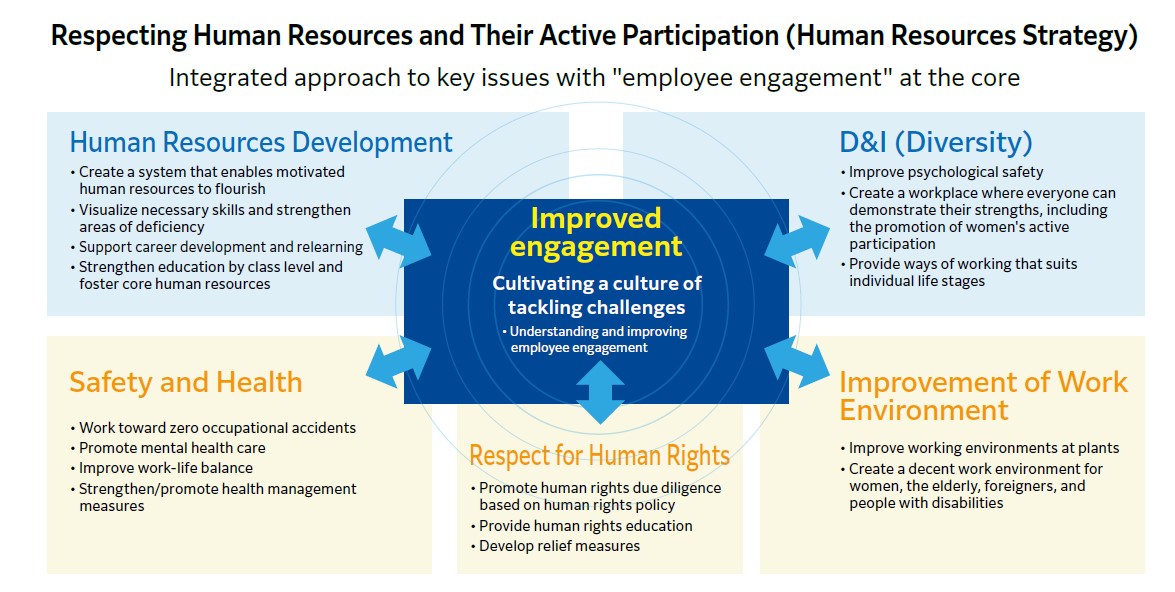
Based on respect for human rights and dignity, we promote the creation of workplaces where employees can work with peace of mind and mental and physical health, and an environment and systems within which employees can demonstrate their creativity and spirit of challenge while feeling job satisfaction and pride in their work.
Approach to Human Resources Strategy
The first is to improve infrastructure. This includes respecting human rights and providing a pleasant work conditions, in order to maximize human resources and improve the work environment.Specifically, we will take steps to prevent harassment, encourage teamwork, and prioritize health and safety for employees.
The second is business growth. This means promoting the growth of our human resources and provide skill development and career support. In addition, we will promote the transformation of our corporate culture to one that encourages challenge.
By taking these two steps, we aim to increase engagement. We will continuously measure and improve our employee engagement. We will also emphasize diversity and inclusion, recognizing the differences among all people and creating a psychologically safe work environment where everyone can fulfill their potential. In this way, we aim to enhance the well-being of our employees and the value of our company.
Respect for Human Rights
Human Rights Policy Formulation
Human Rights Assessment
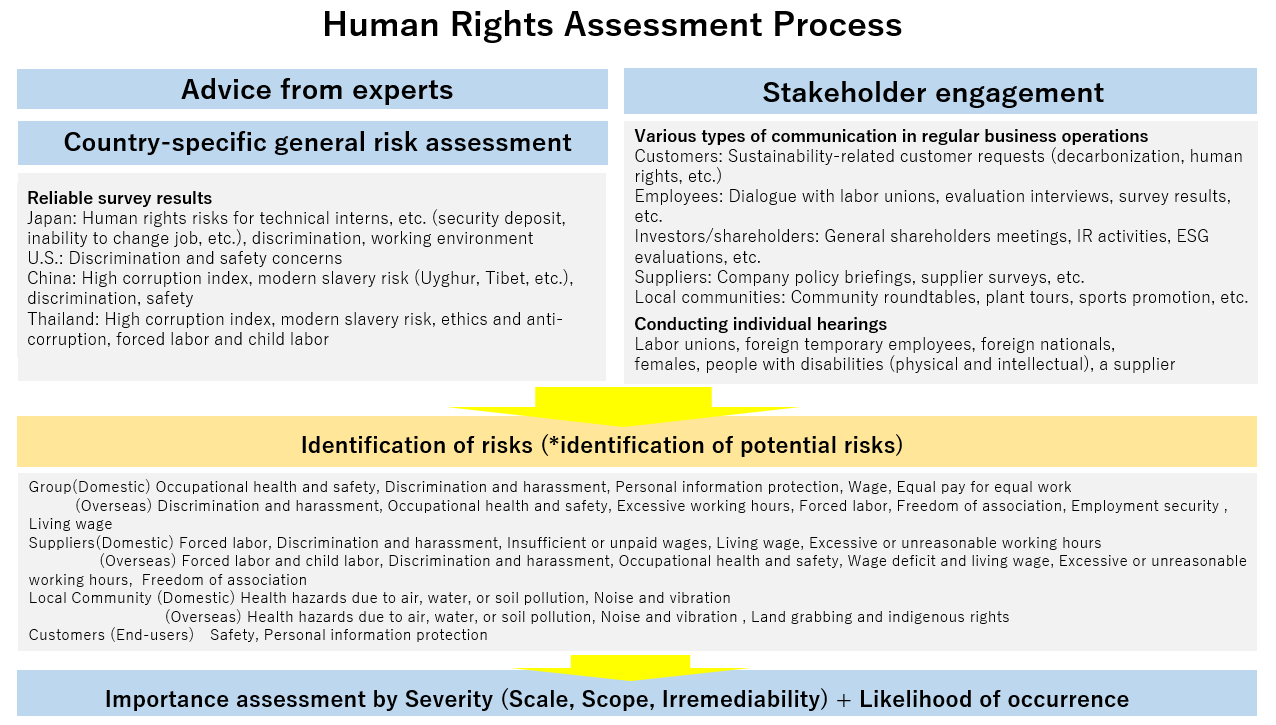
We identified the risks for rights holders based on past advice from human rights experts, general risk assessments by country, and rights-holders engagement (labor unions, foreign full-time employees, foreign temporary employees, women, people with disabilities (physical and intellectual), and a supplier). A materiality revision team (from our Corporate Planning, Environment, Human Resources, Legal, and Procurement divisions) then conducted assessments of severity and likelihood of occurrence.
This resulted in the identification of the following human rights risks for our company: occupational health and safety, discrimination and harassment, forced labor, child labor, working hours, air, water and soil pollution, land grabbing and indigenous rights, and product safety.
Many initiatives are already underway, including occupational health and safety, health management, quality management, and psychological safety improvements; harassment prevention; and research and training on internal and external behavioral guidelines and supplier sustainability guidelines. In particular, we are strengthening our supply chain-related initiatives, including efforts to collect, review, and rectify information on suppliers and provide them with support.
| Domestic | Overseas | Domestic Suppliers | Overseas Suppliersa | Others | Main Initiatives | |
| Occupational health and safety | Employees, especially foreign and non-permanent employees | Employees, especially technical interns | Employees,especially technical interns | Employees | Occupational health and safety, and health management | |
| Discrimination and harassment | Employees, especially,female, LGBTQ people, people with disabilities, foreigners, elderly, sick or injured、and non-permanent employees | Employees, especially non-permanent employees and minolities | Employees, especially technical interns | Employees | Education for the prevention of power harassment and discrimination, D&I initiatives, and SAQs | |
| Forced labor | Employees | Employees | Encouragement, education, and SAQs for suppliers, identification of and support for high-risk suppliers | |||
| Child labor | Employees | Encouragement, education, and SAQs for suppliers, identification of and support for high-risk suppliers | ||||
| Working hours | Employees | Employees | Improvements through distribution of load, digitalization, etc. | |||
| Air, water, and soil pollution | Local communities | Thorough understanding and management of environmental data | ||||
| Land grabbing and indigenous rights | Local communities | Understanding of procurement items of concern such as natural rubber and palm oil, education, SAQs, identification of and support for high-risk suppliers | ||||
| Product safety | End-users | Thorough quality control |
Implementation of Human Rights Surveys
In FY2024, as in the previous year, we conducted a human rights questionnaire, mainly on harassment in the Code of Conduct self-inspection. The results of the surveys were shared with the Human Resources Department to confirm the facts through hearings and other means, and efforts are being made to raise awareness of psychological safety and human rights, establishing a consultation service, and other initiatives. We also conduct questionnaires at overseas entities in the same manner as in Japan, and promote awareness-raising activities during morning meetings and through periodic education.
In FY2025, we conducted e-learning on human rights and included a more in-depth harassment and discrimination topic in the domestic action guideline self-assessment.
Education
Upon the development of our “Human Rights Policy”, in order to raise awareness of human rights within the Group and to put into practice the creation of a corporate culture of respect for human rights, we conduct awareness-raising and educational activities to promote proper understanding of those rights and ensure that information is shared throughout the company.
In FY2024, we worked to promote and instill awareness of respect for human rights by continuing to provide human rights education through e-learning as in the previous year, and by conducting awareness and education to create a group-wide culture of respect for human rights, including harassment education for those promoted to management and supervisory positions.
In FY2025,we are trying to improve employee engagement by conducting department-specific training aimed at enhancing psychological safety, which is closely linked to respect for human rights.
Engagement with Experts and stakeholders on Human Rights
Participants received lectures on human rights-related law, which is being strengthened globally, and human rights issues highly relevant to the automobile industry and the regions the company works in, and exchanged opinions on their practical implementation.
The two leaders provided guidance on things like the importance of taking a stakeholder’s perspective and the importance of conducting risk analysis, setting priorities and implementing initiatives across organizations and groups.
In addition, in October and December 2022, the Corporate Planning Department of parent company in Japan and management of subsidiary in Thailand participated for two days each in the Business and Human Rights Academy training program conducted by the United Nations Development Programme (UNDP) with the support of the Japanese government to deepen their learning. In March 2023, one-on-one meetings were held with Ms. Vanessa Zimmerman (representative of Pillar Two, drafting team for the UN Guiding Principles on Business and Human Rights) and Ms. Emi Sugawara (professor at Osaka University of Economics and Law and head of the Global Compact Research Center). They provided specific advice on our human rights policy and human rights due diligence, including the importance of stakeholder engagement and the effectiveness of using a combination of questionnaires and a Grievance Mechanism.
Human Resource, Safety and Health Policy
The Safety and Health of Employees
In addition, a Health and Safety Committee has been established to investigate and deliberate on basic measures to prevent worker hazards and health problems, and labor and management work together to address these issues. Health and safety risks are assessed at each workplace and prioritized to promote activities to reduce risks.
Human Resource Development
as safety training programs (experiential learning and hazard prediction exercises) using our Safety Dojo.
In FY2024, we continued our risk assessment and safe behavior training while expanding participation to include all temporary employees upon assignment. A total of 608 participants completed the program. These initiatives will be further strengthened as we strive to achieve zero workplace accidents.
Equipment Safety Measures
Providing Proper Work Environments


Health Management
In 2005, we launched our “Work-life Balance” initiative, and since becoming the first workplace to be registered with the Gifu Labor Bureau’s “Hatsu Ratsu Workplace Creation Declaration” in 2006, we have been promoting the mental and physical health of our employees in specific and continuous ways. Placing importance on the health of our employees as the basis for the performance of our human resources, we reaffirmed this position in September 2021 in the Pacific Industrial Group Health Declaration, and are continuing with our health management efforts.
In March 2026, the company was certified as a Health & Productivity Management Organization 2026 (Large Enterprise Category), for the fifth consecutive year. This recognition was given for such initiatives as providing health guidance to those with findings in medical checkups and those at high risk for lifestyle-related diseases, promoting improvements in diet and exercise habits, and supporting the balance between work and treatment for employees who continue to work while undergoing medical care.
As part of our measures against heatstroke, we have clarified the procedures and communication routes for responding to suspected cases of heatstroke, and thoroughly communicated these to ensure a proper response in each workplace. Oral rehydration solutions and cooling packs are also kept on hand in each workplace. Furthermore, every morning before work begins, heat stroke alerts and WBGT forecasts for the day are distributed company-wide via email. This clarifies the warnings that should be given during morning meetings and the times for intensified workplace patrols. Detailed information on suspected heatstroke cases is collected and analyzed to further strengthen preventive measures.
Furthermore, we have unrolled a series of heat countermeasures in our plants, including the installation of air conditioning at the new Higashi Ogaki Plant and Kita Ogaki Plant, adding cooling fans to Nishi Ogaki Plant 1, and applying heat-shielding paint to the roof of Nishi Ogaki Plant 3.
Drawing on absenteeism and presenteeism data, we have also identified back pain as the most common health issue and are implementing both company-wide measures and individual guidance to address it.
In November 2025, at the annual in-house event "Waiwai Festa," we set up a health booth offering dietary assessments, vascular age measurements, and health guidance based on the results. Prior to the event, from September through November, we also held “Waiwai Walking,” a team-based step-count competition designed to promote teamwork and healthy habits. In addition, efforts are being made to improve health literacy by offering opportunities for employees to become more health-conscious, as well as through e-learning programs and themed health newsletters.

Pacific Industrial Group Health Declaration
We believe that sustainable growth of the company will be achieved when all employees are physically and mentally healthy and able to demonstrate their individuality and abilities to create new value.
In order to realize our Purpose of "passion in creating tomorrow," we will promote the creation of psychologically safe workplaces where new ideas and challenges are valued, and try to create an environment where all colleagues can work healthily and vigorously, with satisfaction in their job and happiness in their lives.
October 2023

Tetsushi Ogawa
President, Member of the Board
Pacific Industrial Co., Ltd.
Building of Mental and Physical Health
As part of our efforts to improve mental health, we facilitate consultation with public health nurses and nurses based on the results of stress checks and interview guidance with industrial physicians for employees who want it, and are working on the improvement of workplaces. For employees who work long hours with 45 hours or more overtime per month, if they wish, or at the discretion of the industrial physician, they are interviewed by an industrial physician to understand problems in the workplace and duties. We strive to proactively prevent, early detection and early care for mental health problem.
Employee Engagement
Improving Employee Engagement
Our PURPOSE, “Passion in Creating Tomorrow,” is aimed to empower each of our employees to create new value by maximizing their individual strengths in order to build a sustainable future. To achieve this goal, it is essential that we increase employee engagement. In November 2024, we conducted our second engagement survey, and the results were used to review progress toward our management objectives.
We are focusing on four key priority initiatives to become a company where everyone can thrive and fulfill their potential.
The survey results were shared with all employees, and discussions were held within each department and group to further enhance engagement. The results are also being utilized to create workplaces where employees feel comfortable expressing their thoughts, and to resolve individual issues specific to each workplace.
Priority Action Items
1 Shared the leadership Vision
Main initiatives
• Increasing dialogue opportunities
(Vision sharing meetings, horizontal deployment of safety practices, etc.)
• Resolving workplace issues
2 Relationships with supervisors and colleagues
Main initiatives
• Creating psychologically safe workplaces (Human skills development, harassment
education, psychological safety training,etc.)
3 Sense of growth and learning
Main initiatives
• Enhancing online education
• Introducing AI tools
• Promoting business creation projects
4 Job satisfaction
Main initiatives
• Improving work-life balance(working hours, etc.)
• Enhancing compensation and benefits
• Improving workplace environment(AC, lighting, etc.)
Employee Engagement – Target Positive Response Rate
To questions on 18 factors in 8 categories*1,
positive response rate*2 = 55.8%
*1 Management, business strategy, work style, supervisors, colleagues, work, growth opportunities, evaluation.
*2 Responder chose “Strongly agree” or “Agree” from the options “Strongly agree”, “Agree”, “Neither agree nor disagree”, “Do not agree”, “Strongly disagree”.
Setting target values
FY2026 = 60%, FY2030 = 70%
Creation of a secure and vibrant work environment
Creating a Decent Work Environment
As a specific example, in 2022, the start time at our Kyushu and Tohoku plants was revised from 6:00 to 7:10 to reduce the physical burden on factory workers, and from January 2025, it was also revised to 7:10 in the Gifu area.
Good interpersonal relationships are also important for a comfortable workplace, and so we expanded our mentor system to assign young senior employees to not only new administrative staff but also new technical hires. We also monitor employees’ physical and mental well-being while fostering human resource development,such as through pre-assignment training for managers and supervisors, and regular interviews with new employees. We also strive to create a workplace with a high level of psychological safety by holding regular informal discussions where employees can talk freely to management or labor unions about their thoughts and feelings on their work, as well as any problems they face. We conduct psychological safety training for new managers and supervisors too.
As part of our support activities, we also continuously strive to improve the workplace environment from the perspectives of people, facilities, and environment.
Converting Non-Regular Employees into Regular Employees
Promoting Work-Life Balance
We implement a variety of measures to help employees balance a fulfilling personal life with job satisfaction and growth. We have received Kurumin certification every year since 2008 as a child-rearing company, and in July 2024, we received Platinum Kurumin certification. Our target for annual paid leave is set at 12 days per year. We are working to ensure that this goal is met. In FY2024, the average rate of achievement of this goal was 100% for union members for the fourth year in a row.
Reflecting employee feedback, in March 2025 we received Platinum Kurumin Plus certification following the introduction of leave for infertility treatment. We are also expanding and revising various systems, such as removing any limit on the number of paid half-days employees can take.
We have introduced flexible work styles, such as encouraging the use of annual paid leave, reducing long working hours, ensuring rest periods through a work interval system, and using reduced working hours, staggered working hours, and a flextime system to support the balance with childcare or nursing care.
Going forward, we will continue to strive to create an environment and culture that supports work-life balance,allows employees to easily take time off, and encourages healthily and energetic work.

Slogan of Work-Life Balance
- Family bonds and personal growth
- Workplace bonds and company growth
- Social bonds and regional development
Support for the Balancing of Work and Child-Rearing
Since the Act on Advancement of Measures to Support Raising Next-Generation Children came into effect in 2005, the company has developed and expanded systems that support the balancing of work and family. Parental and nursing care leave periods are set at two years, which is above the legal standard. There is no limit on the number of changes, and systems have been established that allow employees to choose various work-styles in accordance with their individual life stages and circumstances.
We have received Kurumin certification in 2008, 2011, 2016, and 2020 as a child-rearing company, and in July 2024, we received Platinum Kurumin certification from the Ministry of Health, Labour and Welfare as a company that supports the development of the next generation positively. Additionally, in March 2025, our efforts to support employees balancing infertility treatment and work were recognized, earning us the Platinum Kurumin Plus certification.

We are working on a “Parental Leave Support Program” to provide support before, during and after leave to employees who take parental leave, and working on the creation of an environment and culture in which the entire workplace supports childcare so that employees can raise their children with peace of mind and return to work smoothly.
In addition, we are also working positively on measures to support childcare, such as tie-ups with company-led daycare centers and registration as an excellent company for childcare with Gifu Prefecture.
| Parental leave period | Until the child reaches 2 years of age |
|---|---|
| Number of times parental leave can be taken | Leave can be taken and changed as many times as required |
| Changes to work start and end times, staggered work hours | Until the child reaches elementary school age (60 minutes each per day) * Until the end of elementary school grade four based on conditions |
Development of Human Resources and Cultivation of Culture that We can Tackle New Endeavors
Human Resources Development Policy
Strengthen Education at Each Level
In FY2024, we are adding new training programs and expanding the scope of existing ones. In addition, to create psychologically safe workplaces where employees can freely voice their opinions and ask questions regardless of their position or years of experience, we have launched department-level training initiatives beginning in 2024.
Learning Opportunities
Personnel System and Welfare
Personnel System
Welfare
Diversity and Inclusion
Policies and Initiatives
Active Roles of Non-Japanese Employees
The group has set the target of increasing the ratio of non-Japanese managers to 53% or more by FY2030.
For foreign workers to understand, we have created foreign language versions of medical examination questionnaires in common areas, hygiene-related guidelines, training materials for new hires, work manuals, and other materials.
Employment of People with Disabilities
Ongoing Employment of the Elderly
Promotion of Women’s Activities
We believe that the further advancement of women is essential for a company's sustainable growth and corporate competitiveness, and are therefore hiring capable human resources regardless of gender, create a work environment that allows for diverse work styles, and promoting career education necessary for individual growth. To strengthen our recruitment of women, we are working with each department to address the low ratio of females in technical positions, with the goal of hiring 15 women by 2030. Specifically, during new graduate recruitment, female technical employees participate in information sessions for high school students, where they explain the fulfilling aspects of their work in a roundtable format. In addition, our Human Resources staff visit high school career counselors to describe examples of successful contributions made by our female employees, which has led to actual recruitment.
In addition, based on the view that men’s participation in childcare is necessary for women’s advancement, we support our male employees in taking childcare leave, with 75.4% of them taking leave in FY2024. We have also prepared a “Childcare Leave Handbook for Men” , which includes detailed explanations of the subsidy system to alleviate concerns about earning less when taking childcare leave, as well as explanations of the procedures from a male perspective and interviews with those who have taken long-term leave. In June 2024, we received Eruboshi certification from the Labor Bureau after our implementation of initiatives to promote the advancement of women was found to meet the certification criteria.

Female officers (As of Mar. 31, 2025)
| Number of Famale | Managers | Assistant Manager | |
|---|---|---|---|
| Administrative positions | 100 | 5 | 23 |
| Technical positions | 19 | 0 | 3 |
| Technical staff | 69 | 0 | 0 |
| Total | 188 | 5 | 26 |
* The numbers of managers and assistant managers are included in the number of female employees.


Communication between Labor and Management
Dialogue with Labor Unions
Regular monthly labor-management council meetings are held between strategic officers, including the president, and union officers to confirm the status of overtime and paid leave utilization, and we actively report and exchange opinions on employment stability, working conditions, health and safety, and the status of production and sales activities between labor and management to promote labor-management harmony. In addition, labor management roundtable meetings and production committee meetings are held in each business division. These meetings are forums for communication to ascertain the status of safety measures and other measures that have been put into practice, discussing issues for the betterment of the company, and consulting on any problems.